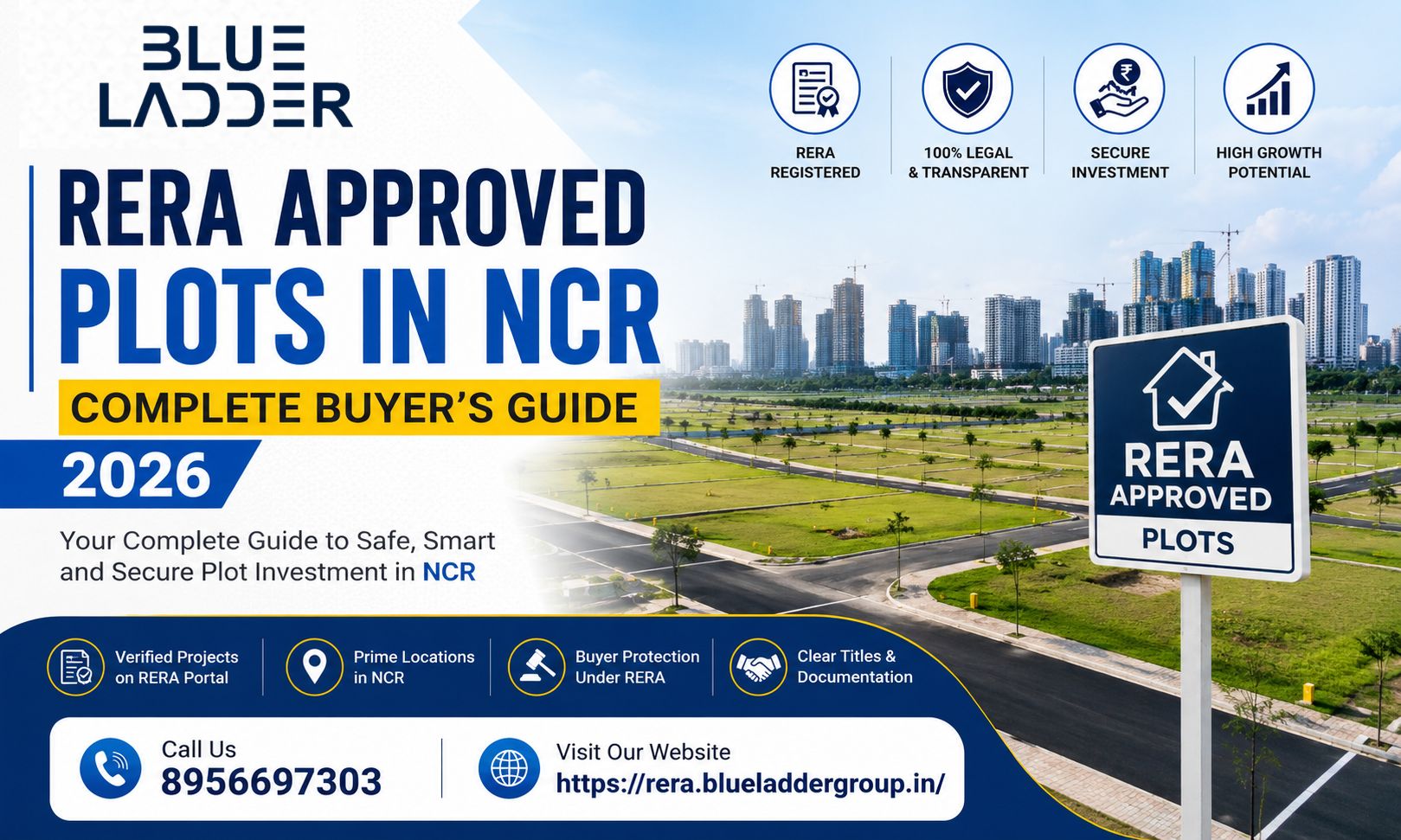
RERA Approved Plots in NCR: Complete Buyer's Guide (2026)
Investing in RERA approved plots in NCR is honestly the smartest way to lock in your money in one of India’s most fast-moving real estate arenas. With big infrastructure work like the Dwarka Expressway, Jewar Airport, and the Delhi-Mumbai Expressway coming in and quietly reshaping land values across the National Capital Region, buyers now get both the chance. and the responsibility … to invest the right way. This quick guide basically covers what you should know before you go sign on the dotted line.
Why RERA Registration Matters for Plot Buyers in NCR
The Real Estate (Regulation and Development) Act, 2016 did something major to how property deals happen across India. Before RERA, plot buyers had very limited legal standing when a developer defaulted, delayed timelines, or gave mismatched promises about a project. Now it’s changed in a fundamental way. Under RERA, any plotted development project that goes beyond 500 square metres, or involves more than eight plots has to be registered with the correct state authority before it can be marketed or sold. That one condition wipes out a large slice of the older fraud pattern that used to be quite common in peri-urban NCR zones.
For buyers in the NCR there are three regulatory bodies that actually matter. Haryana RERA (HRERA) governs projects in Gurugram, Sohna, Manesar and surrounding districts. UP RERA covers Noida , and Greater Noida too. Delhi RERA handles projects within the capital territory. Each portal lets you check a project’s registration number , developer details, and quarterly progress updates all before you pay even a single rupee , so yeah it’s the first gate you should walk through.
⚡ Quick fact: Since RERA implementation, NCR has seen over 45% decline in project-level disputes, and plotted developments with valid RERA registration have shown better price stability and faster completion rates.
What RERA Registration Gives You (Not Just Promises)
When you purchase a RERA registered plot, a set of safeguards kicks in automatically. The developer has to deposit 70% of the collected money into a dedicated escrow account, and that money can only be used for construction and land-related costs. This helps stop the kind of fund redirection that made thousands of projects get stuck earlier, before RERA was in place.
Also, the developer cannot take more than 10% of the plot value as an advance before a registered Agreement for Sale is executed. It basically keeps buyers from paying big amounts first, without proper legal paperwork. And if possession gets delayed without a valid reason, you can demand either a full refund with interest or compensation, whichever you prefer, so you’re not left hanging.
How to Check RERA Approved Plots in Delhi NCR
This should take less than ten minutes, and honestly it should be the very first step in your buying journey. Don’t trust the developer’s talk or rely on that glossy marketing brochure. Instead verify it yourself.
- For Gurugram, Sohna, Manesar, Bahadurgarh, and Jhajjar: go to haryanarera.gov.in. Then choose HRERA Gurugram or HRERA Panchkula based on where the project sits. Under the Projects section, click Registered Projects and search using the project name, the developer name, or the registration number that the agent gives you.
- For Noida, Greater Noida, and nearby UP pockets: use the UP RERA portal at up.rera.gov.in. In 2025 alone, UP RERA logged 308 projects, and out of that 122 sit in NCR-adjacent growth corridors, like those connecting belt regions where development suddenly speeds up.
- For Delhi, look at the Delhi RERA portal at rera.delhi.gov.in.
After you spot the project, don’t just stop there. Confirm the registration is active (meaning not expired), match the developer’s name with everything you’ve received in writing, and check that the project timeline is still current. Also take a look at the Quarterly Progress Report QPR, because developers are legally required to refresh it. This is the real construction picture versus what they might be saying in marketing.
Documents to Demand Before Booking
Beyond the portal, ask the developer directly for these documents before you pay even a booking amount. The RERA registration certificate with the unique registration number is non-negotiable. You should also review the sanctioned layout plan that was approved by the local authority, the land title papers showing clear, unencumbered ownership, and the Encumbrance Certificate covering the past 30 years from the sub-registrar’s office.
Additionally, ask for Mutation records (Daakhil Kharij) so you can confirm the ownership has been updated correctly in revenue records. Finally, cross-check the plot coordinates against the official Master Plan, to make sure the land isn’t marked for green belt controls, road widening, or any government acquisition. This comes up more often than people think in the NCR fringe, where change happens quickly.
Best Locations for RERA Approved Plot Investment in NCR
Choosing the location is basically the second-biggest decision, right after legal verification. NCR gives you multiple micro-markets across different price slabs and growth stages.
On Sohna Road, things have shifted a lot. It has moved from a kind of semi-rural stretch, into a legitimate residential corridor. The KMP Expressway, connects Sohna directly to Manesar and Palwal reduces commute times quite a lot. Manesar, placed along NH-48 it also ends up taking advantage of proximity to Gurugram’s industrial belt and that fast-growing auto sector. Here RERA-registered plotted developments give investors a sort of clear paperwork, plus decent rise potential, as infrastructure slowly settles in and matures.
Plots in these micro-markets feel extra appealing because HRERA has been fairly firm about enforcing compliance, so it is one of the safer NCR districts for plotted investment, overall.
Bahadurgarh sits at the junction of Delhi and Haryana, and is reachable through the Delhi-Bahadurgarh Metro extension along with NH-334B. Land prices here stay comparatively affordable compared with Gurugram, though the growth rhythm is still strong. Jhajjar, further on the KMP corridor, is offering plotted land at some of the more budget-friendly rates within the NCR belt, this suits investors looking at a five-to-seven year horizon.
Both places have witnessed increased RERA registrations, from developers who earlier operated in a kind of regulatory grey zone. That change alone, can be read as market maturation.
The Dwarka Expressway corridor has already delivered impressive results for the early crowd. Farrukhnagar, lying along the corridor’s southern extension toward Pataudi Road, feels like the next logical growth node. It provides relatively affordable plots with direct connectivity to the Dwarka Expressway, Gurugram city centre, and the coming Global City development. Investors across this belt have reportedly seen 2x to 3x appreciation over four to five years, in comparable sectors.
Legal Checks Every Plot Buyer Must Complete
Beyond RERA verification, a few additional legal steps protect your investment from future disputes.
- Start with GST verification on the developer— confirm their 15 digit GSTIN is actually valid.
- Next check how the land is classified in revenue records, whether it is agricultural, residential, or commercial. Because agricultural land cannot be used for residential plotted development without NA (Non Agricultural) conversion. This is one of those critical details that many first time buyers overlook, honestly.
- Then do a real on site check of the plot’s boundary demarcations, and compare them with the layout plan. Mismatches in boundary walls or access roads are pretty common in big plotted townships, especially when multiple phases are under development at the same time. If you spot any mismatch, raise it formally with the developer and make sure their response is documented in writing.
- Before you sign the Agreement for Sale, consult a property lawyer. The legal review cost is modest compared to the total transaction size, and a qualified lawyer can flag clause level risks that a general buyer might not notice. For instance, clauses that allow developers to change plot allotments or alter commitments related to common areas.
Understanding the Agreement for Sale Under RERA
The Agreement for Sale is probably the most important document in the entire transaction. Under RERA, its format is partially standardized, but developers still keep some flexibility in certain clauses. So ensure the agreement clearly mentions the plot number, the exact dimensions, the total consideration, the payment schedule, the possession date, the penalty for delay, and the specification of every promised infrastructure item— roads, electricity, water, drainage, and boundary walls.
Also remember, any verbal promise made by the sales team that is not included in the agreement has no legal standing. Therefore, make sure you have everything down on paper before you hand over any money, except the initial booking amount, ok?
Common Mistakes NCR Plot Buyers Make — and How to Avoid Them
A lot of buyers skip the RERA portal check completely, because the developer gives a registration number that “looks” credible, sort of. Still, those same registration numbers can be quoted for expired projects or for a project that is not even the right one. The safe move is to verify the number straight on the state portal — it barely takes three minutes, and it costs nothing.
Another common slip is buying plots in townships that are marketed as “RERA compliant” but they are actually filed under the Town and Country Planning (TCP) framework, not RERA. TCP projects come with different rules and generally less buyer security. So ask, very clearly, if the project has an actual RERA registration number, don’t just rely on planning approval alone.
Buyers also often underestimate why escrow compliance matters. The developer might be registered on RERA, but funds can still get misdirected if buyers are not keeping an eye on the quarterly disclosures. The RERA portal posts financial reports, so review those before every installment payment, not after.
And last, don’t buy a plot just because someone promised a good location, if you have not confirmed infrastructure delivery timelines. In NCR growth corridors things can feel fast but roads, electricity hookups, and water supply may end up being years away, even after possession. Request exact dates from the developer, and cross-check those dates with government project timelines from official sources.
Making Your Investment Decision With Confidence
Buying RERA approved plots in NCR can be a sturdy, protected way to build long-term wealth, as long as you handle the due diligence part properly, yes. The regulatory framework, together with NCRs structural demand that comes from corporate expansion, infrastructure development, and population growth makes plotted land one of the most resilient asset classes, available for Indian investors today.
At Blue Ladder Group, our team has guided hundreds of buyers through verified plot transactions across Gurugram, Sohna, Manesar, Bahadurgarh and the Farrukhnagar belt. Every listing we put forward includes complete RERA documentation, clear title checks, and an on-ground infrastructure assessment so you can make your decision with evidence, not just assurances. Browse our RERA-approved plot options or just talk to our advisory team to find the right opportunity, aligned to your budget and investment timeline.

